Four algorithm families
Explore six sorting, five pathfinding, three maze-generation and two searching algorithms.
ئەلگۆریتم
See the logic. Follow every step.
A Kurdish algorithm playground for sorting, searching, pathfinding and maze generation. Visual steps, pseudocode and statistics turn abstract procedures into something you can inspect.
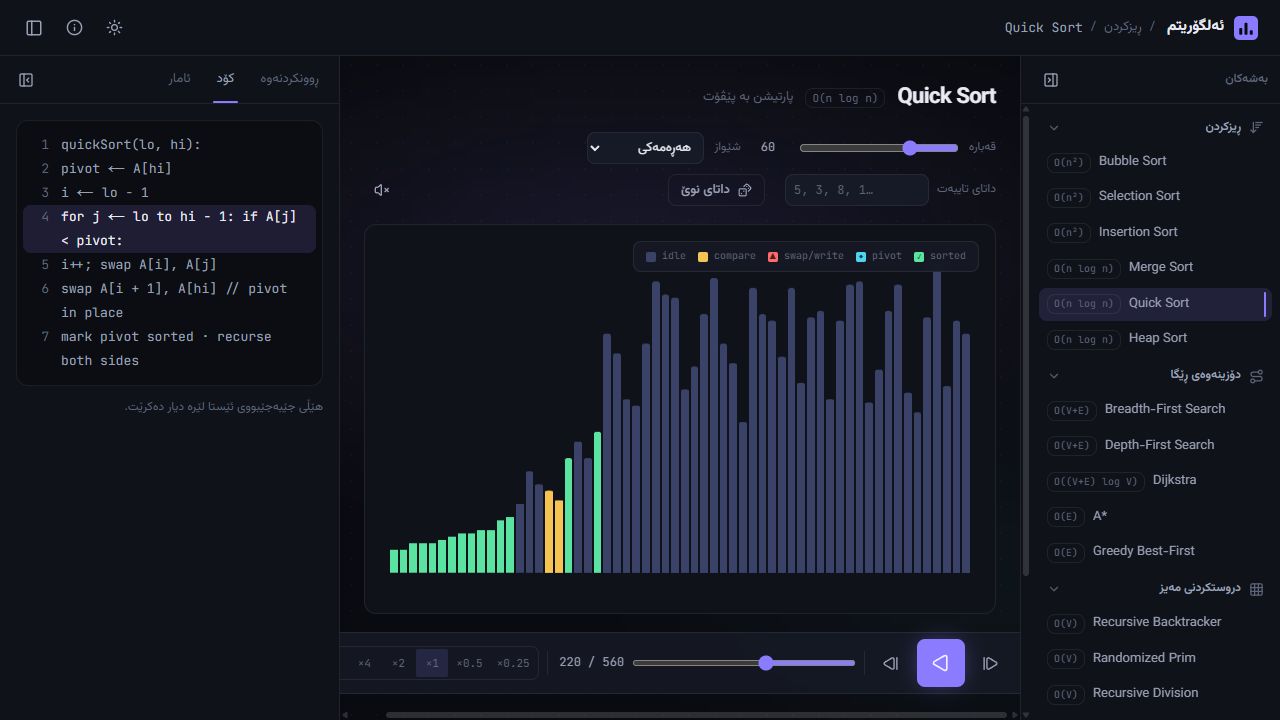
Reading pseudocode often hides the part that matters most: how the state changes from one operation to the next. Learners need a way to slow down, revisit a step and connect the code to its result.
Keep the visual state, pseudocode and statistics synchronized. Let visitors choose the input, control playback and experiment with the same idea on different arrays or grids.
Explore six sorting, five pathfinding, three maze-generation and two searching algorithms.
Play, pause, step forward or back, seek through the timeline and adjust speed while following the corresponding pseudocode.
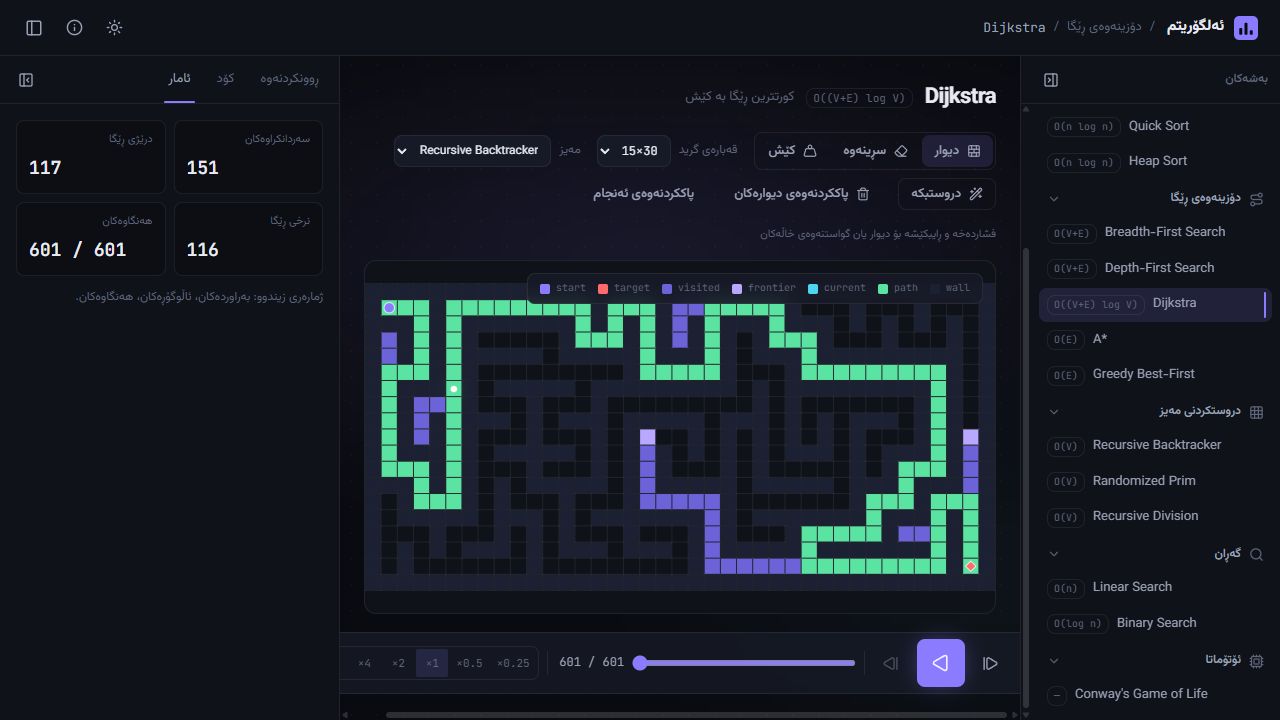
Edit walls and weights, generate a maze and find a route. A separate Conway’s Game of Life simulation explores another kind of evolving system.
Design choices become useful when the system underneath supports them.
Algorithm runs produce inspectable steps. Playback can revisit those states, keeping the visual explanation and pseudocode aligned rather than relying on a one-way animation.
Algorithm-specific statistics expose comparisons, swaps, visited nodes and path cost. The interface makes the work performed by an algorithm visible.
Canvas rendering supports walls, weighted cells and generated mazes. State management coordinates the chosen algorithm, input and playback controls.